Artemis II is the first crewed flight of NASA's Artemis programme and the first time humans have travelled beyond low Earth orbit since Apollo 17 returned from the Moon in December 1972. Four astronauts rode the Orion spacecraft on a free-return trajectory that took them around the far side of the Moon and back to a splashdown in the Pacific, clearing the path for a crewed lunar landing on Artemis III.
The Crew
Four astronauts were assigned to Artemis II, three from NASA and one from the Canadian Space Agency under the Artemis partnership. This was the first time a non-American astronaut has flown to the Moon.
- Reid Wiseman — Commander (NASA). U.S. Navy test pilot, veteran of a long-duration stay on the International Space Station.
- Victor Glover — Pilot (NASA). U.S. Navy aviator, previously pilot of the first operational Crew Dragon flight to the ISS.
- Christina Koch — Mission Specialist (NASA). Holder of the record for the longest single spaceflight by a woman and a veteran of the first all-female spacewalk.
- Jeremy Hansen — Mission Specialist (Canadian Space Agency). Former fighter pilot, making his first spaceflight and Canada's first flight to deep space.
The assignment itself was historic before a single bolt was tightened: first woman, first person of colour, and first non-American assigned to a lunar mission.
The Launch Vehicle and Spacecraft
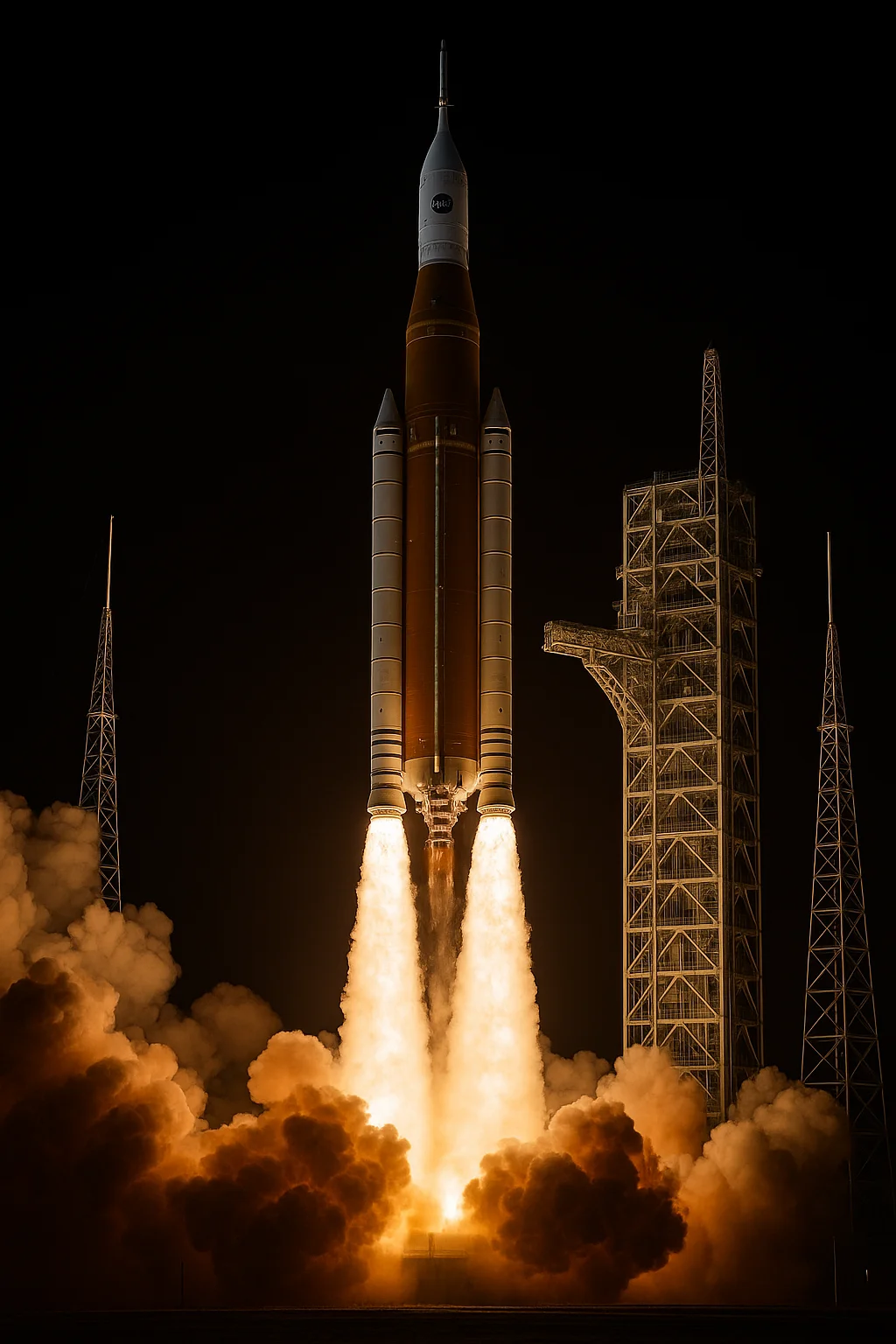
Artemis II used the same basic stack that flew Artemis I, with the important difference that it carried people. The Space Launch System (SLS) Block 1 provided roughly 8.8 million pounds of thrust at liftoff, placing the Orion spacecraft and its Interim Cryogenic Propulsion Stage (ICPS) into a high Earth orbit.
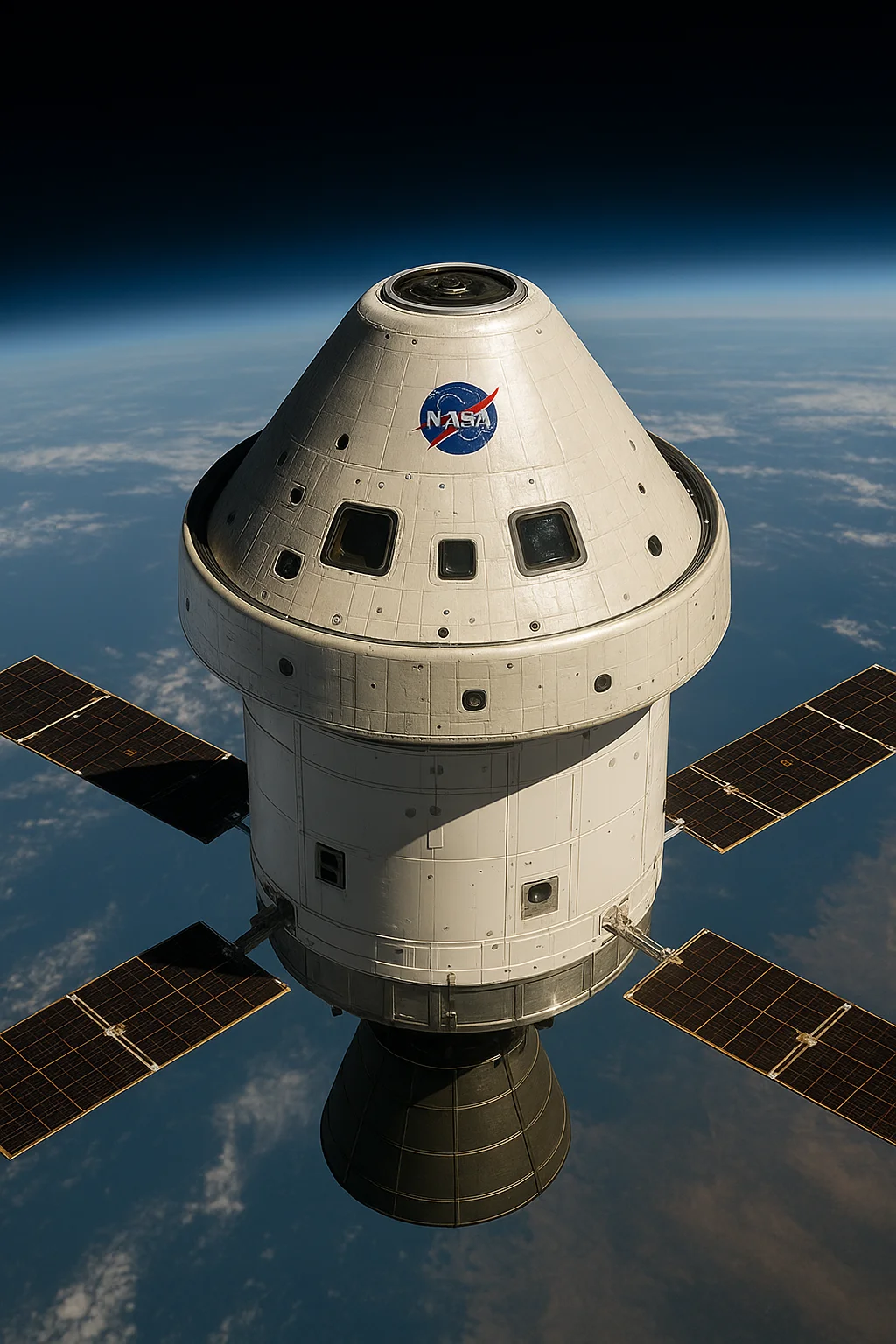
Orion is a two-module spacecraft: a pressurised crew module built by Lockheed Martin for NASA, and a European Service Module provided by ESA and built by Airbus, which carries the main engine, solar arrays, propellant, water, oxygen, and nitrogen. The service module is jettisoned before re-entry; the crew module is the only part that returns to Earth.
Compared with the Apollo Command and Service Module, Orion has more internal volume, modern avionics, and a heat shield designed for lunar-return velocities of about 11 km/s — nearly 40 percent faster than return from low Earth orbit, which is why re-entry is one of the mission's most-watched events.
Mission Profile
Artemis II was a circumlunar mission, not a lunar orbit mission. The trajectory is often called a "hybrid free-return": if the service module engine had failed at any point after trans-lunar injection, the spacecraft's path would have naturally carried it back to Earth without needing a major burn. This was chosen deliberately to keep the first crewed flight conservative.
The flight plan broke down into four major phases.
1. Launch and High Earth Orbit Checkout
After liftoff, the core stage and boosters delivered Orion and ICPS to a high elliptical Earth orbit. For roughly a day, the crew stayed in Earth's gravity well while running a structured checkout of every spacecraft system that could not be fully tested on an uncrewed flight: life support loop humidity balance, displays, cabin acoustics, the toilet, the manual docking test with the spent ICPS, and a series of proximity-operations burns evaluating how Orion handles at close range.
2. Trans-Lunar Injection
With the spacecraft cleared for deep space, the ICPS fired to raise Orion's apogee beyond the Moon. After that burn, Orion separated from the upper stage and began coasting outbound under its own power and the ESA service module's engine for any small trajectory-correction manoeuvres.
3. Lunar Flyby
About four days after launch, Orion swung around the far side of the Moon. The closest approach brought the spacecraft to roughly 10,300 km above the lunar far side — further from the Moon than Apollo flyby distances, because Artemis II was optimised for a clean free-return, not for orbit insertion. During the flyby, the crew observed the far side through the spacecraft's windows, captured high-resolution imagery, and reached a distance from Earth greater than any crewed spacecraft has achieved, surpassing the Apollo 13 record.
4. Return and Re-entry
After the flyby, the Moon's gravity slingshotted Orion back toward Earth. The return leg is the longest passive stretch of the mission, used for deep-space demonstrations of star-tracker navigation, communications at lunar distances, and deep-space optical-link testing. Roughly 10 days after launch, Orion jettisoned its service module, re-oriented heat-shield-forward, and entered the upper atmosphere at about 11 km/s. A "skip" re-entry profile — dipping into the atmosphere, skipping back up briefly, then the final descent — spread out the peak heating and g-loads before the main parachutes deployed for a splashdown in the Pacific off the California coast.
What the Mission Was Actually Testing
Artemis II is often described as a "lunar flyby," which is accurate but undersells what it existed to do. The free-return trajectory is not the point; the point is everything the crew and ground teams had to verify that Artemis I could not.
- Life support with a real crew loop. Artemis I flew mannequins instrumented for radiation; it could not validate a human-in-the-loop environmental control system over 10 days. CO2 scrubbing, humidity, thermal comfort, noise, and water recovery were all data points that only a crewed flight could produce.
- Communications and navigation at deep-space distances. Orion relies on the Deep Space Network, plus on-board star tracker and optical navigation. Artemis II exercised every mode a crewed Artemis III mission would use for lunar operations.
- Manual spacecraft handling. The proximity-operations demonstration near the spent ICPS tested the crew's ability to fly Orion manually — essential for rendezvous with Gateway or a Human Landing System on later missions.
- Lunar-return re-entry. The heat shield performance at 11 km/s re-entry had been demonstrated on Artemis I, but the full guidance, navigation, and control loop that keeps a crew inside human-tolerable g-limits during a skip re-entry had to be flown with people aboard.
- Radiation exposure data. Outside Earth's magnetic field, the crew accumulated a well-characterised deep-space radiation dose that feeds directly into shielding and mission-duration decisions for longer-duration flights to Mars.
Why This Mattered
A flyby is not a landing. It did not add a new bootprint to the lunar surface, raise a new flag, or collect a rock. What it did was close the gap between an uncrewed test flight and a crewed surface landing — a gap that, on the Apollo programme, was closed by Apollo 8 and Apollo 10 in 1968 and 1969.
Artemis II is the modern equivalent of that step. The same vehicle architecture, the same flight profile discipline, and the same operational readiness have to be demonstrated before committing astronauts to a surface landing with a human lander, a spacesuit system, and polar-site operations that all have their own first-flight risks.
It also had a symbolic weight that is hard to overstate. For more than 50 years, every crewed spaceflight — from the Shuttle era to Soyuz to Crew Dragon — had stayed below roughly 600 km above Earth. Artemis II took humans a thousand times further than that, and brought them home.
What Comes Next
Artemis III is the first crewed surface landing of the programme. Its profile is substantially more complex than Artemis II: Orion launches on SLS to lunar orbit, rendezvouses with a Human Landing System based on a variant of SpaceX's Starship that has already been pre-positioned in lunar orbit, transfers two astronauts to the lander, and descends to a site in the south polar region. After a surface stay of several days, the lander returns the crew to Orion for the journey home.
Several elements on the Artemis III critical path still have their own first flights ahead of them: the Starship HLS in its lunar-landing configuration, the Axiom xEMU-derived lunar spacesuits, and the propellant-transfer architecture Starship uses to reach the Moon. None of these depended on Artemis II, but the crewed-flight readiness that Artemis II proved is a prerequisite for committing to any of them.
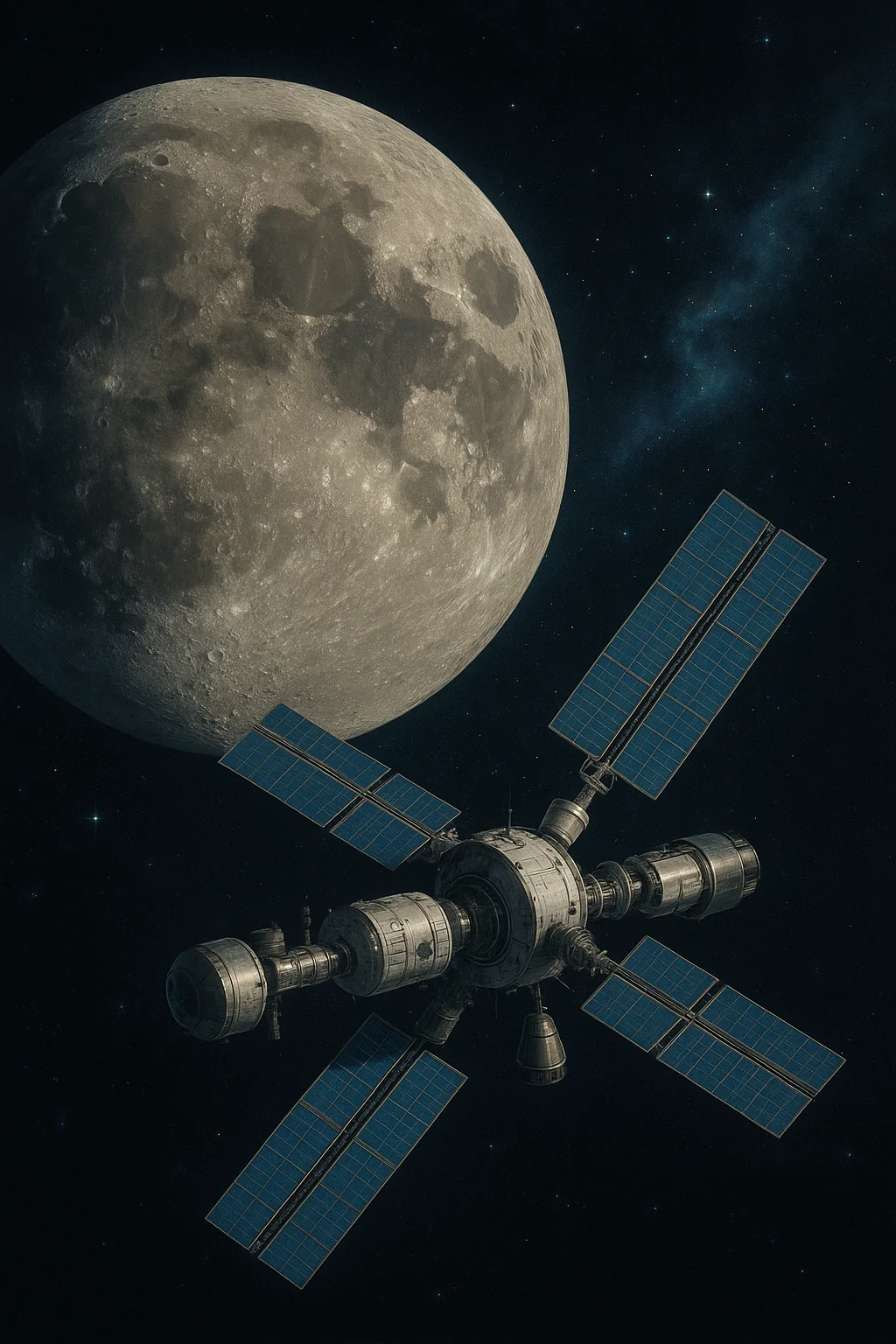
Beyond Artemis III, the programme schedule includes the first Gateway modules in near-rectilinear halo orbit around the Moon, additional crewed landings, and the gradual build-out of surface infrastructure intended to support longer stays. Whether those dates hold is a separate question; the direction of travel is not in serious doubt.
How to Read the Mission
The cleanest way to understand Artemis II is as a carefully bounded de-risking flight. It was not the programme's destination, it was the step that made the destination reachable. Everything unusual about its profile — the hybrid free-return, the conservative flyby distance, the extensive Earth-orbit checkout before trans-lunar injection — exists because this was the first time a crew had ridden this stack. Treat Artemis I as the "does the hardware work alone" flight; Artemis II as the "does the hardware work with people" flight; and Artemis III as the first real attempt to do something new on the lunar surface. Read in that order, the programme's decade-long arc makes sense.